Welcome to my portfolio

How AI Is Changing Search
And What an AI-Generated Infographic Taught Me About Its Limitations
Ruth
4/28/20263 min read
SEO has long been the way websites get discovered, especially for small businesses. But as AI continues to generate quick overviews in search results, I want to understand how I can optimize my clients' websites and my own to still be found when someone searches for services like mine locally.
AI search is reshaping how people find answers. People are no longer only relying on traditional search engines — they're also turning to AI-driven tools and recommendations like ChatGPT, which directly impacts what information shows up and what doesn't. And the effects are significant.
According to a recent Seer Interactive study, AI overviews have caused organic click-through rates to drop by up to 61% (Forbes, 2026). AI is not only impacting employment, it's also making it harder for small business owners and creators to be discovered.
By prioritizing certain content, AI influences what gets seen and what products get recommended, ultimately affecting user behavior and making traditional traffic-driving methods less effective than they once were (Witte, 2025).
To research this topic, I used NotebookLM — I had heard about it in a content marketing webinar a few months back but this was my first time actually trying it out for my Social Media Marketing course. I wanted to test its ability to find and pull quality sources while also adding a few of my own, so I selected Modern Marketing Today, a leading digital industry community where thought leaders share strategies and best practices for using innovative technology to address modern marketing challenges (Modern Marketing, 2025). Other credible sources — including Search Engine Journal, Drive Traffic, Stanford University, and Forbes were chosen for the relevance and value they brought to the topic.
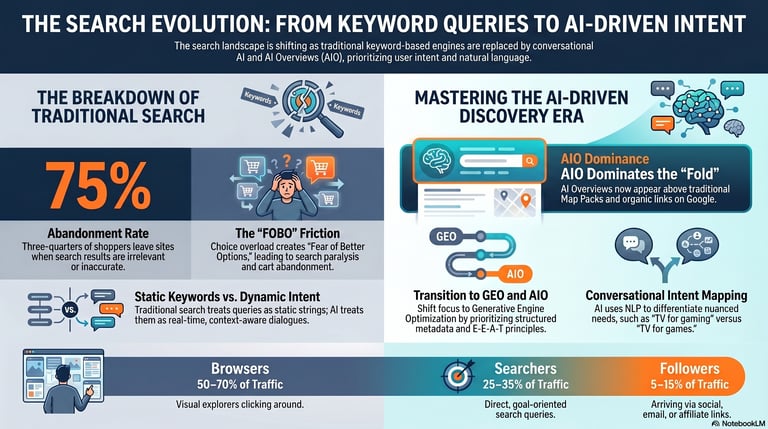
NotebookLM also generated the infographic below to visually present the information, and that's where things got interesting — because reviewing it ended up being just as telling as the research itself.
What I realized when AI generated the infographic
While NotebookLM did a solid job pulling relevant sources, the infographic it generated had some clear limitations that are actually worth talking about.
On the surface, it did a few things well — the use of different colors made it visually appealing, and iconography was used to help communicate the information. But as a tool meant to make complex information easier to digest, it missed the mark in several ways.
The graphic leaned heavily on jargon and overly complex language that someone might not easily understand at first glance. It also included several fragmented phrases with no real explanation of what they meant in context. For example, the line "Traditional search treats queries as static strings; AI treats them as real-time, context-aware dialogues" left me more confused than knowledgeable. And after going back through the source articles, I found that the most relevant and useful information wasn't even included in the infographic at all.
It also didn't cite any sources within the graphic itself — which is a real problem. Pulling information from multiple sources without crediting where it came from raises copyright concerns and disregards the work of the original creators. For a tool being used in academic or professional settings, that's a major flaw.
This is actually a limitation worth considering when using AI to generate visual content: AI can pull and organize information, but it doesn't always know what matters most, how to present it clearly for a general audience, emotionally connect through design, or how to give proper credit to original sources. Those are still very human judgment calls.
As someone who creates content and designs for small business clients, this was a good reminder that AI is a useful starting point — but the strategy, clarity, creativity and context still have to come from us, the human. The same way AI search is changing how businesses get discovered online, AI-generated content is changing how information gets communicated. And in both cases, understanding the limitations is just as important as understanding the possibilities.
The bottom line: AI is changing the rules of how businesses get found online, and as someone who works with small businesses and creators, staying on top of these shifts matters — not just for me, but for the clients who depend on their online presence to grow.
Follow along as I continue learning, testing, and sharing what actually works for small businesses in this evolving digital landscape.
Disclaimer: This article was written by a human, edited to perfection by AI using my own thoughts, ideas, voice, and research.
Sources
George, J. (2026, April 27). Search has shifted to generative AI-Is it Recommending your brand?. Forbes. https://www.forbes.com/councils/forbesagencycouncil/2026/04/27/search-has-shifted-to-generative-ai-is-it-recommending-your-brand/
Google. (2026). NotebookLM (April 28 version) [Large language model]. Google. https://notebooklm.google.com/
Witte, F. (2025, March 26). A New Search Is Born: AI is changing the search landscape. ModernMarketingToday. https://modernmarketingtoday.com/a-new-search-is-born-ai-is-changing-the-search-landscape/